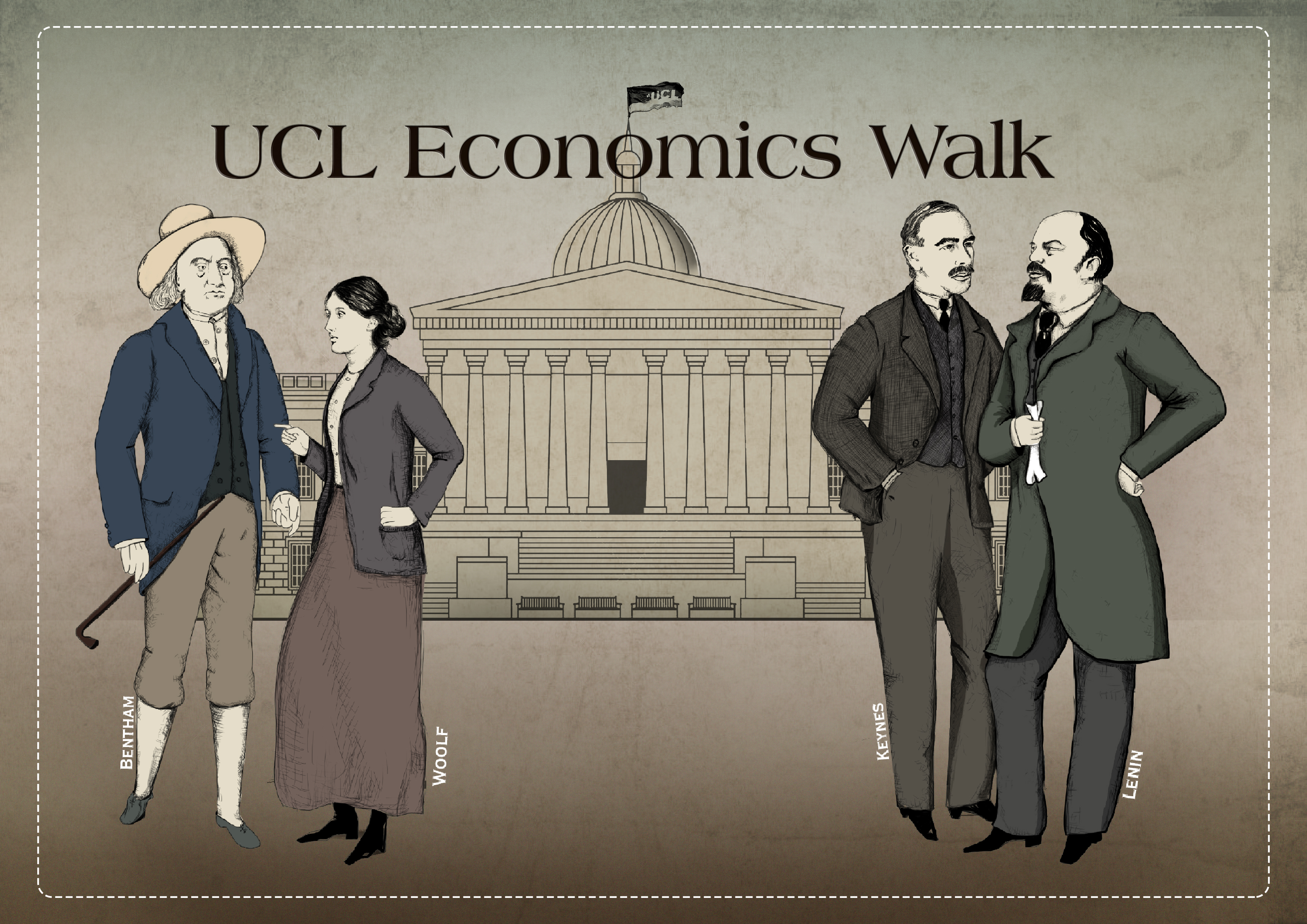
This walking tour will take you onto an intellectual journey from the early 19th century until today. Walking in the streets of Bloomsbury, we visit places associated with Jeremy Bentham, David Ricardo, Vladimir Lenin, John Maynard Keynes, Virginia Woolf, George Orwell and other profound thinkers. We will explore how these thinkers shaped the history of the 19th and the 20th century and will discuss the relevance of their ideas to today’s world. The tour will take about 90 minutes. Also, a virtual version of this tour is offered via Zoom.
Stay updated with our upcoming in-person and virtual tours by checking this website regularly. For direct updates, consider subscribing to the Economics Walk mailing list. Please note: the tour is open to everyone, but registration is required.
If you are a module leader and would like to incorporate the in-person or virtual tour in your module, please contact Dr Ramin Nassehi directly (r.nassehi@ucl.ac.uk) to schedule a tour.

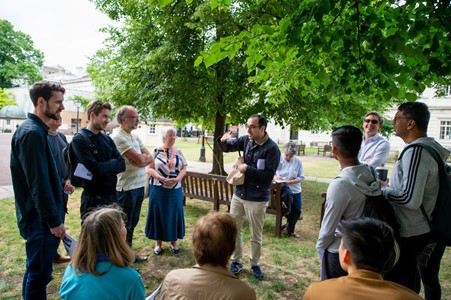
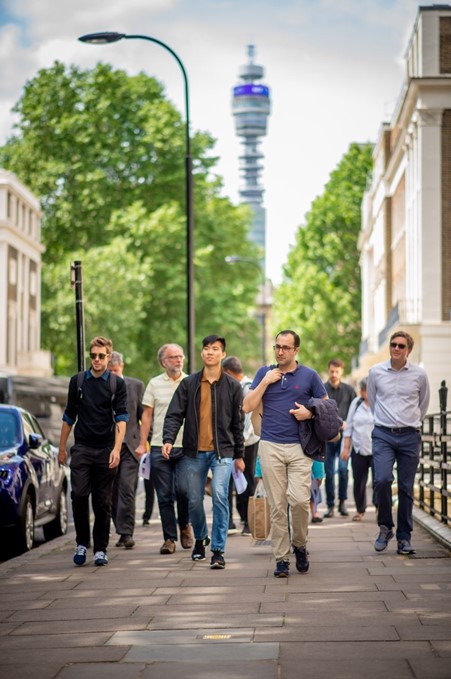
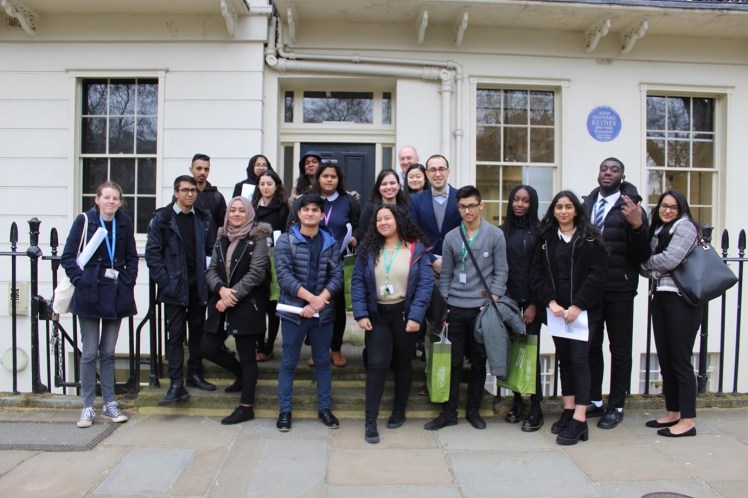
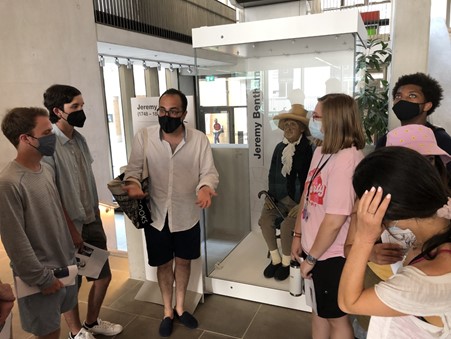
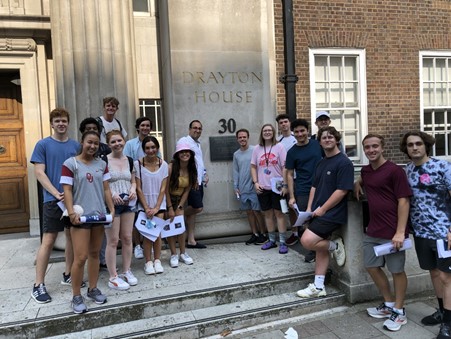
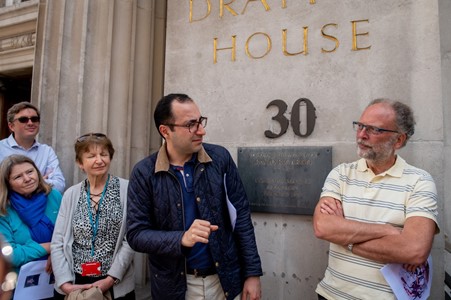
This tour mainly targets undergraduate and postgraduate economics students but is also open to students or members of the public who have an interest in economics, politics or intellectual history. It also targets high school students who are soon going to apply to universities, aiming to spark their interest in studying economics. So far, this tour has been offered to more than 500 attendees, including students and academics from various universities around the world, secondary school students and members of the public. You can read the reviews of Phin Godfrey (UCL student) and Professor Gregory Burge (University of Oklahoma) of this tour. This video, presented as a part of TeachECONference2021‘s asynchronous sessions, gives an overview of the tour and its pedagogical innovations:
Tour leader
Dr Ramin Nassehi, Associate Professor (Teaching) at the Department of Economics at University College London. Ramin’s interest is on economics pedagogy, particularly in the ways in which economists can better communicate their ideas to the public. He has been involved in various education projects such as Royal Economic Society’s “Discover Economics”, Explore Econ (UCL student conference), and EconFrame (economics photo competition). He is also a contributor to CORE Econ project. Ramin has won numerous education awards including the Best Lecturer Award at the UCL Department of Economics (2017/2018) and SOAS Director’s Prize in Inspirational and Innovative Teaching 2016/2017.
Aims of this Project
The primary aim of this project is to explain various key economic concepts by tying those concepts to certain locations. Another aim of the tour is to break down the barriers of the conventional classroom; by going outside the lecture room and into the streets, the tour automatically creates a more equal footing between the guide (lecturer) and the participants, paving the way for a more inclusive conversation and debate.
Thirdly, the tour aims to make high school students interested in studying economics for their university degrees. Economics is often narrowly conflated with finance in the minds of high school students. By going through an intellectual history of the discipline, the tour shows that economics has so far dealt with various subjects from tackling cost of living (monetary policy), recessions (fiscal policy), income inequality (welfare policy) and environmental problems. Accordingly, this tour has been offered as part of the Royal Economic Society’s Discover Economics initiative, which runs widening participation campaigns in high schools to increase diversity in economics.
The final aim of the tour is to involve students as co-presenters in the tour. This not only helps them improve their communication skills but also gives them agency to tell the economic story of their campus and streets around their university through their positive and normative prism. The main inspiration of this tour has come from London’s Economics Walks paths created by Professor Ian Preston.
Virtual tour:
The tour is also offered online via Zoom (70 minutes). It innovatively combines the Green Screen technology with a customised Google map to create a virtual sense of London’s locations in Zoom. You can view short snippets of it here and here. Here is the teaser of the tour. Ramin usually co-presents this tour with students.


Economics Walk as a teaching tool
The tour uses a mixture of storytelling about historical characters, quantitative historical data and interactive discussion to explain the following economic concepts:
- Utilitarianism (Context: Jeremy Bentham’s auto-icon)
- The Gold Standard, Debt/GDP (Context: 19th century globalisation)
- Comparative advantage (Context: 19th century globalisation)
- Labour productivity, capital accumulation, technological progress (Context: British Industrial Revolution)
- Income Inequality (Context: British Industrial Revolution)
- Keynesian fiscal and monetary stimulus (Context: The Great Depression)
- Taxation and welfare state (Context: Post-WWII Britain).
The tour’s handout weaves together the historical characters, economic concepts and quantitative data. This tour can be incorporated as an assessed or non-assessed activity in an undergraduate or postgraduate economics module. For example, the in-person version of this tour has been integrated as an assessed component in the intermediate macroeconomics module in King’s College Business School. George Washington University and University of Oklahoma have also incorporated the virtual version of the tour as a non-assessed activity for their undergraduate economic students. The tour guide can pick and choose from the above concepts depending on the content and level of the module. Overall, the walk can be integrated with the following modules:
- Economic history
- History of economic thought
- Principles of economics
- Intermediate macroeconomics
- Economics of growth and inequality
- Labour and public economics
The tour can be complemented with a series of pre- and post-activities. The pre-activities can include reading a short article about, let’s say, the Gold Standard or watching a video about diminishing returns to capital accumulation. For instance, the King’s College students were given this reading list for preparation. Post activities can include writing a reflective essay about the tour, submitting photos or answering problem sets or short questions about the concepts and historical data covered in the tour. As an instructor, if you wish to add this activity to your module, please contact Dr Ramin Nassehi (r.nassehi@ucl.ac.uk) directly to schedule an in-person or a virtual tour.
Alternatively, other instructors can develop their own economic walking tour based on their campus or city (or create a joint tour with London Economics Walk). This place-based method of teaching economics can be applied more widely to any location or an object that has an economic story to tell like a historical landmark, a town bridge or even a supermarket. Not all locations that we visit in the London Economics Walk relate to a famous economist; for instance, one of our stops is an art deco building from the 1920s where we discuss the impact of the Second Industrial Revolution, characterised by the advent of electricity and elevators, on the emergence of tall buildings and modern cities. So, this project can be potentially tailored to different campuses, towns and cities.
Pedagogical Innovations
Firstly, this tour offers a location-based method of teaching economics. Each visiting location is used as a case study or an “associating object” for an economic idea. For instance, when visiting the house of Vladimir Lenin in Bloomsbury the tour discusses the contemporary problem of growing income inequality, specifically the declining share of labour income and the rise of top 1%. In this way, each location is associated with a particular economic problem and a set of relevant economic theories. This weaving of ideas to places, makes economic theories more intuitive and easier to remember for the audience. Secondly, the tour adopts a dialogic approach in economics teaching. This means that, instead of transferring knowledge and facts to the audience, lecturer (tour guide) initiates a discussion about a real-world economic problem with the aim of enabling participants to “discover” economic knowledge or arrive at economic theories. Finally, the tour innovatively integrates various digital technologies in economic storytelling. For instance, the face-to-face version of the tour uses QR codes (in the printed handout) for some visiting locations to direct the audience to relevant online resources like short videos, articles or documentaries on the topic under the discussion. To find out more about the aims and innovations of this project read Ramin’s working paper: “UCL Economics Walk: A place-based method of teaching economics”. This has been presented in various conferences including UCL Education Conference on April 2021; APT Conference on July 2021, Southern Economics Association Conference on Nov 2021.
This project closely relates to the First Year Challenge, another exciting CTaLE project. In terms of pedagogy, both projects follow a placed-based method of teaching economics. But as a public engagement project, the walking tour follows a different aim, which is to communicate economics to a general audience through an interactive collective journey across several Bloomsbury locations. At the end of the tour, participants are asked to fill out an evaluation form and provide suggestions for further improvements. Here are some quotes on what participants liked the most about the tour:
“Actually feeling the physical connection to the great economic/political thinkers that are familiar from classes. Thrilling experience. Explanations intuitive, well-structured. Brilliant.”
“The tour guide gives a very clear outline of the intellectual history development, which is related to the UCL. This is very interesting because I seldom get the chance to learn it inside classes. The point of view of economics as a science of philosophy rather than a branch of applied mathematics is very inviting.”
“Absolutely, [the walk] should be required for UCL faculty.”
“Explanations and connections with economic history from multidisciplinary view.”
“The way it was interactive. The interlinking of the different economic and social and political thoughts through the years.”
Questions?
Email Ramin at r.nassehi@ucl.ac.uk
 ctale.org